
ecoPayz Withdrawal Pending at Casinos: What the Wait Really Means
 Available in GB
Nothing tests a player’s patience like the word pending sitting next to a withdrawal they have been waiting for. I have talked dozens of people off the ledge who were convinced a pending status meant the casino was stalling, inventing reasons, or refusing to pay. Almost every time, the truth was duller and more reassuring than the story they had built.
A pending withdrawal is usually not the casino dragging its feet out of malice — it is a normal processing and review stage doing exactly what regulation requires it to do. Understanding what happens during that wait turns a maddening silence into a predictable, explainable pause. The status is not a verdict. It is a queue.
So let me demystify the pending stage, because the anxiety it causes is almost entirely a product of not knowing what is going on behind it. I will explain what the casino is actually doing while your withdrawal sits pending, why the checks exist, and how to tell a routine wait from a genuine problem. Most pending withdrawals resolve themselves; knowing which ones might not is the useful part.
What the Casino Is Doing While You Wait
The pending status is not an empty void where your money sits ignored — it is an active processing window during which the casino is doing specific, required work. Most withdrawals pass through a review stage before the money is released, and pending is simply the label for that stage.

During that window the casino is typically verifying a few things: that your identity and account are in order, that the withdrawal does not trip any anti-money-laundering or responsible-gambling flags, and that the funds are being returned correctly. This is not optional diligence the casino performs out of caution; it is regulatory obligation, and the consequences of getting it wrong are severe. Operators have been hit with penalties running into the hundreds of thousands of pounds — one firm faced £650,000 in fines for anti-money-laundering and social-responsibility failures — so the review you experience as an irritating delay is the same review that keeps the operator on the right side of its licence. The pending stage is the system working, not the system failing. From your side it looks like inaction; from the casino’s side it is a checklist being worked through.

Knowing this reframes the wait entirely. A pending withdrawal is the casino doing its legally required homework before handing over money, and a competent operator processing that homework promptly is behaving exactly as it should. The delay is a feature of a regulated system, not evidence of a reluctant one.
Best casino sites in the UK
- BeOnBetBonus: 100% up to €500 + 100 FS · Payout speed: 1-3 business days
- EvoSpinBonus: 125% up to €2500 + 125 Free Spins · Payout speed: 1-3 business days
- BritsinoBonus: Welcome Package – Get your £2,200 + 2,000 FS · Payout speed: 1-3 business days
- Revery PlayBonus: 100% up to€1,000+ 100 FS · Payout speed: 1-3 business days
- SlotoSportBonus: 500% up to £ 10 200+ 777 FS · Payout speed: 1-3 business days
- ZombillionBonus: Welcome Pack 250% up to £4000 + 200 FS · Payout speed: 1-3 business days
Why Verification Sits at the Heart of It
The single biggest cause of a longer-than-expected pending stage is verification, and it is worth understanding why it lands at the withdrawal rather than the deposit. Casinos are often relaxed about taking your money in and far more careful about paying it out, and that asymmetry is deliberate.

The withdrawal is the natural checkpoint for know-your-customer and source-of-funds review because it is the moment money leaves the regulated environment. If your identity documents are incomplete, your account is not fully verified, or something about the pattern of play warrants a closer look, the withdrawal is where that gets resolved before funds move. This is also why the wallet’s own verification matters: a fully verified Payz account, run by FCA-authorised PSI-Pay Ltd under registration number 900011, presents a clean, confirmed destination for the funds, whereas an under-verified one can add a layer of friction at exactly the wrong moment. The two verification systems — the casino’s and the wallet’s — are doing complementary jobs, and gaps in either can extend a pending stage. The smoother both are, the faster the queue moves.

This is the practical reason I push people to complete every verification step early, while no money is on the line. Sorting your identity documents at both the casino and the wallet before you ever win means that when a withdrawal does land, the pending stage has the least possible to chew on. Verification done in advance is verification that cannot delay you later.
Telling a Normal Wait From a Real Problem
Not every pending withdrawal is purely routine, and the useful skill is distinguishing the ordinary wait from the one worth acting on. The good news is that the signals are fairly clear once you know what separates them.

A normal pending stage resolves within the casino’s stated processing time, communicates clearly if it needs documents from you, and ends with the money moving to your wallet, after which the wallet’s own near-instant settlement takes over. A problem looks different: a pending status that drags well past the published window with no explanation, repeated or escalating document requests that seem designed to exhaust you, or vague non-answers from support when you ask for a timeline. The first kind you wait out; the second kind you document and pursue. The distinction is whether the operator is processing or stalling, and the tell is communication — a casino doing its job tells you what it needs and roughly when you will be paid, while one looking for reasons not to pay goes quiet. This is also where the broader habits around withdrawals pay off, since a clean method trail and a verified account give a stalling operator far less to hide behind, which is the heart of getting ecoPayz casino withdrawals to run smoothly in the first place.
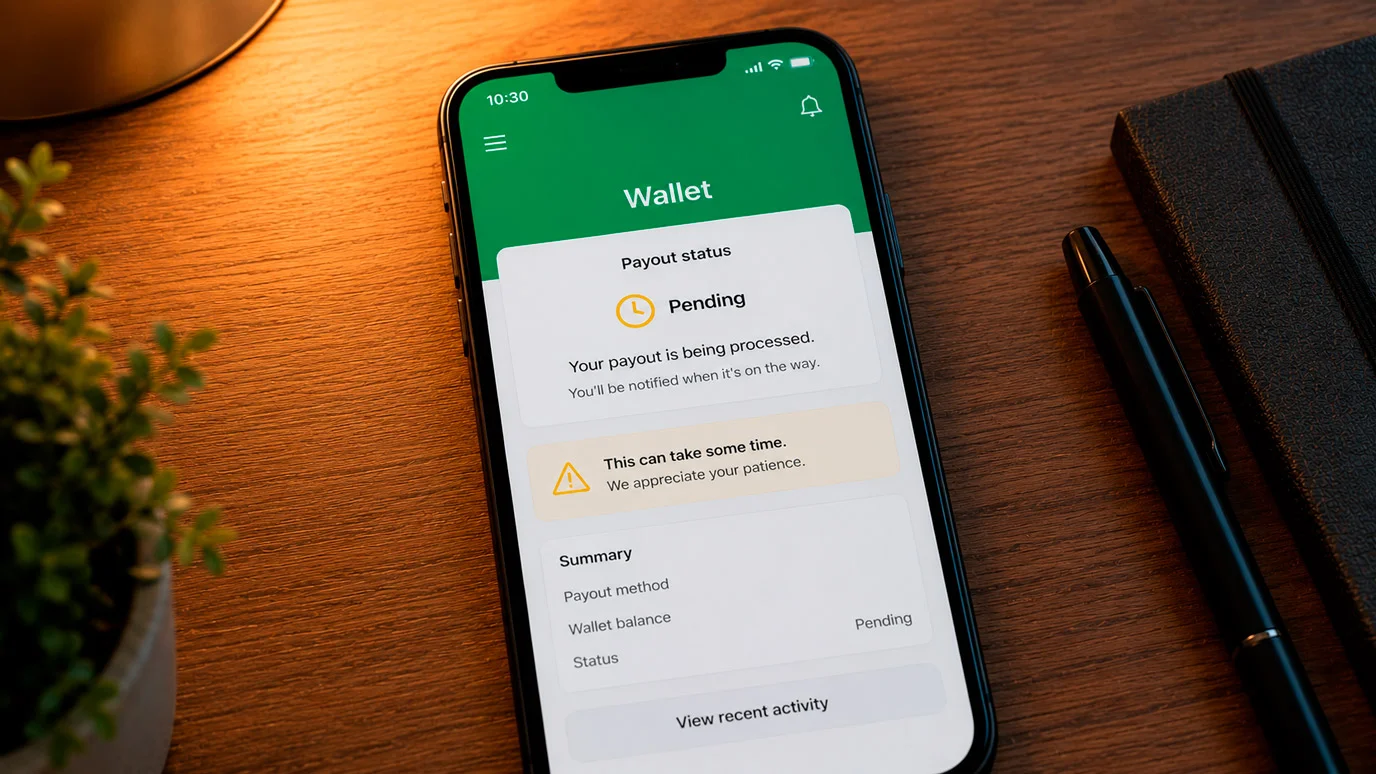
So treat pending as information rather than threat. Most of the time it is the regulated machine turning over exactly as designed, and your money is closer than your impatience suggests. Reserve your concern for the specific warning signs — silence, runaround, drift past the stated window — and you will know the rare moment when patience should turn into action.
Written by the editors at Vaultline.