
Casino Dice Games in the UK: How the House Edge Works
 Available in GB
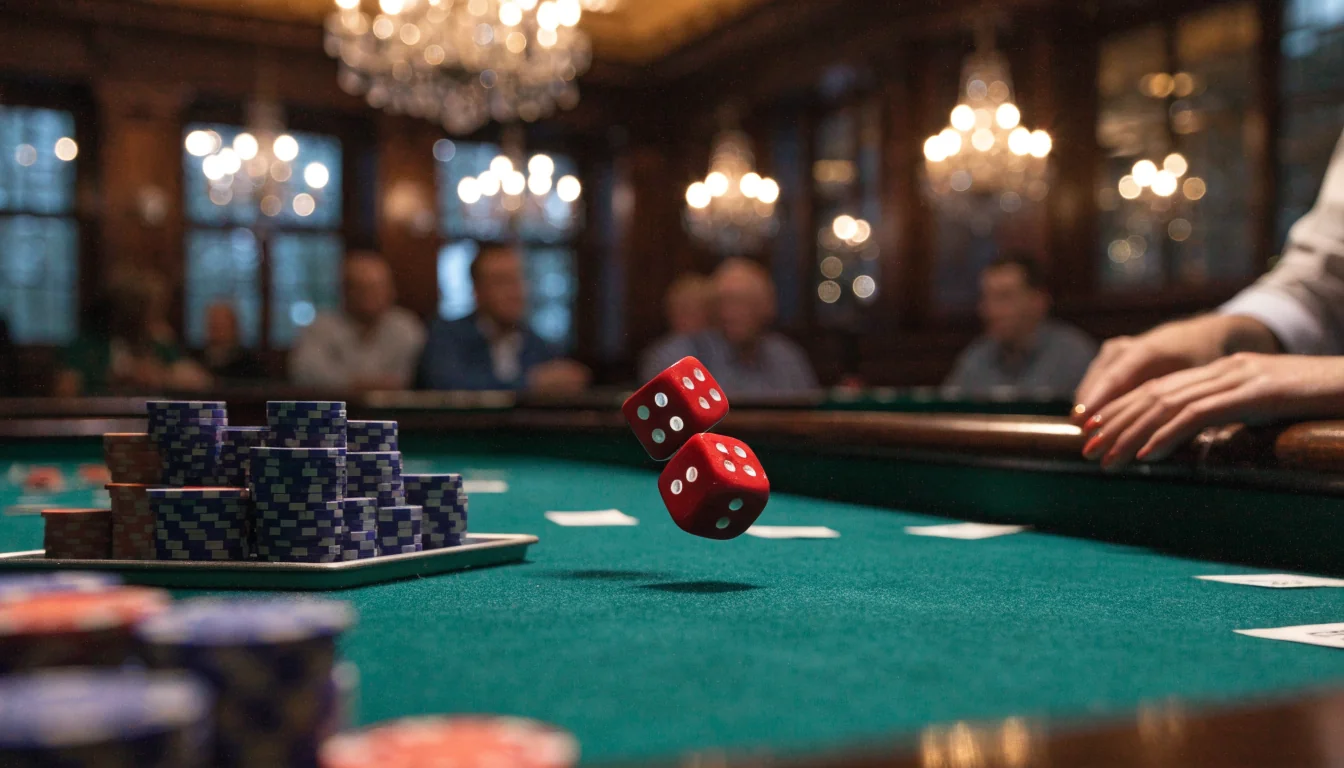
A practical explanation of wager outcomes, the house advantage over repeated play, and how dice games sit alongside slots and other casino formats.
What the Casino Takes from a Dice Game
A dice wager begins with a simple exchange: cash or chips are placed on a possible outcome, or on a combination of outcomes, and the result determines whether the stake is lost or a return is paid. The apparent simplicity can hide the commercial arrangement. A casino game is not priced as a fair exchange between equal parties; over time, its structure gives the house a predictable advantage.
That advantage is not a promise that the casino wins every round. A player can win a particular wager, and a run of results can favour the player for a while. The house edge describes the longer view: across repeated play, the game is structured so that the casino has the favourable position. Short-term gains remain possible, but they do not cancel the underlying imbalance.
I find it useful to separate two ideas that advertising often blurs: the result of an individual roll and the economics of the game over time. One result can go either way according to the wager and the outcome. The casino’s advantage is not a prediction of what will happen next. It is a feature of the arrangement across play, not a forecast for the next round.
That distinction matters because a win feels like evidence about the game. It is evidence that the player won that wager. It does not show that the game has become favourable, or that the next outcome is due to compensate for earlier losses. Likewise, a losing result does not establish that a win must follow. Each wager is settled on its own terms; the long-term advantage is expressed across the structure of the game.
Mines Casino Game in the UK: Risks and Randomness
The money at risk is concrete. Cash or chips are staked against possible random outcomes, and the player may receive a return when the selected outcome occurs. A winning return can include the stake as well as a gain, depending on the terms of the wager. The important commercial point is not the label attached to the return but the balance between what can be won and how often the relevant outcomes occur. That balance is where the casino’s advantage resides.
A “good chance” is not the same thing as a favourable wager. A selection might appear to cover a broad set of outcomes, yet its potential return and the frequency of those outcomes also matter. Without those terms, a broad-sounding selection tells little about the value of the bet. I would not judge a dice game by how simple its choices look; simplicity makes the decision easier to follow, not necessarily more favourable.
The same applies to language such as “easy win” or “quick payout”. Those phrases describe an impression, not the underlying balance. The casino earns its position through the game’s structure, while the player accepts uncertainty in exchange for the possibility of a gain. There is no contradiction in saying both that a player can win now and that the casino holds the advantage over time. They refer to different scales of play.
This is why a short winning session cannot establish that a game is generous, just as a short losing session cannot reveal a hidden pattern. A sequence of results can look striking without changing the wager’s terms. The visible roll is immediate; the commercial advantage is less visible because it becomes meaningful across repeated outcomes.
The word “best” needs care in this context. It can suggest that one casino or game is objectively superior, when a ranking would require clear criteria and comparable terms. For the wager itself, the useful questions are more modest: what outcome is being backed, what happens when it occurs, and what is the relationship between the stake and the return? Those details explain the offer better than a promotional label does.
Chicken Road Game in UK Casinos: Mechanics and Checks
A dice game is therefore not simply a contest of nerve against chance. The player chooses where to stake cash or chips, while the casino supplies a game whose long-run economics favour the house. Individual wins are real; so is the structural advantage. Keeping both facts in view is the clearest way to understand what the casino takes from a dice wager. Short term, uncertain. Long term, designed.
Best casino sites in the UK
- BeOnBetBonus: 100% up to €500 + 100 FS · Payout speed: 1-3 business days
- EvoSpinBonus: 125% up to €2500 + 125 Free Spins · Payout speed: 1-3 business days
- BritsinoBonus: Welcome Package – Get your £2,200 + 2,000 FS · Payout speed: 1-3 business days
- Revery PlayBonus: 100% up to€1,000+ 100 FS · Payout speed: 1-3 business days
- SlotoSportBonus: 500% up to £ 10 200+ 777 FS · Payout speed: 1-3 business days
- ZombillionBonus: Welcome Pack 250% up to £4000 + 200 FS · Payout speed: 1-3 business days
How Online Dice Games Generate Outcomes
An online dice game has a visible layer and a result-producing layer. The visible layer is the screen: it shows the game, the available choices and, once a round is complete, its outcome. Behind that display, a random number game uses selected random numbers generated by a computer or other gaming equipment. The number-generation process supplies the outcome; the animation is how the result is presented.
That distinction matters. A digital die may appear to tumble across the screen, but the animation itself need not be what determines the result. In a random number game, the relevant question is how the outcome is generated, not how convincing the rolling effect looks. A smooth animation can make a result feel physical, but it does not, by itself, explain the process behind it.
I find it useful to separate what can be seen from what can be inferred. A player may see a die face, a number, or another result on the screen. That is the displayed outcome. The fact that it is displayed as a roll does not establish that a physical die was thrown, nor does the visual sequence reveal how the underlying number was selected. The interface communicates the result; the random number process produces it.
JetX Casino Game in the UK: Slots or Crash?
From selection to displayed result
In an online casino, the game is made available through a digital service where permitted by law. The player interacts with a screen rather than handling casino equipment directly. In random number games, a computer or other gaming equipment generates selected random numbers. The game then presents an outcome associated with that process.
This is a plain description, but it avoids a common confusion: a game can look like a dice game without every visible movement being part of the result-generation method. The roll animation is not evidence of a physical throw. Nor is the speed of the animation a reliable way to judge how the number was generated. The visual presentation and the selection process are different parts of the experience.
When considering online casino dice games, it is therefore better to think in terms of a result being generated and then shown, rather than imagining that the screen must be reproducing a table event. The interface may use familiar dice imagery, but imagery does not disclose the technical arrangement behind it. The general point is narrower and more dependable: random number games use selected numbers generated by a computer or other gaming equipment.
What randomness does—and does not—tell us
The word “random” describes the kind of outcome process, not a promise about what any particular round will show. A result can be surprising or familiar; neither appearance tells the player what the next result will be. A short run of outcomes is not, on its own, an explanation of the system that generated them. Equally, a repeated number does not prove that a game has stopped using a random process.
That is where presentation can encourage assumptions. A sequence that looks dramatic may seem to carry a pattern, while a quiet sequence may appear more ordinary. Those impressions come from observing displayed results. They do not supply a method for predicting the next selection. The screen offers a record of what has appeared, not a view into the process that selected it.
In random number games, the interface communicates the result through animation, but the outcome is produced by a computer or other gaming equipment.
This point applies whether the interface is described as an online dice casino or simply as casino dice played online. The wording changes; the underlying distinction does not. A random number game relies on generated selections, while the graphics provide a readable and familiar way to show the outcome. No animation can make a previous result a dependable guide to a later one.
Reading the interface carefully
A well-presented game makes it clear what the player is selecting and what result has been recorded. The display may use dice, numbers or other visual cues, but those cues should be read as part of the interface. They are not a technical account of how the game produces its outcomes.
I would not treat a realistic roll, a pause before the result, or a sound effect as proof of a particular mechanism. Those are presentation choices. The meaningful distinction is whether the game belongs to the random number game format, where selected random numbers are generated by a computer or other gaming equipment. That explanation is enough to describe the general online process without pretending that the screen reveals details it cannot show.
The result is generated; the animation follows its meaning. Short version.
Table Games, Machines and the Wider Casino Mix
A casino floor is not one kind of game repeated in different packaging. The important distinction is often how play is organised: a table game has a dealer or croupier and a shared playing space, while a gambling machine is generally used by one person at a time without an employee running the game. That difference shapes the pace and feel of a session, even before the rules are considered.
Live Dream Catcher Casino UK: Game and Operator
At a table, players compete against the casino, not against one another. The dealer conducts the game, manages the sequence of play and applies its rules. Other players may be seated nearby, but their presence does not turn the game into a contest between them. From behind the counter, I found that this distinction matters: a table has a visible human role, but the outcome is still determined by the game’s rules rather than by the dealer choosing who wins.
Dice table games fit into this wider category. The dice are part of the equipment and the way a result is represented; they do not, by themselves, define the whole experience. A casino game involving dice still has rules that determine what a roll means, when a decision is made and how the result is settled. That is why searching for a “dice game” can lead to different expectations: the phrase describes a component, not necessarily a single format.
Machines work differently. A player normally interacts with the machine alone, and no croupier is needed to manage each turn. This makes the format self-contained: the player makes an input, the machine presents a result, and the next play can begin without a table procedure. The absence of an employee does not mean there are no rules; it means those rules are built into the game rather than administered at a staffed table.
Table Games
Dealer-led games with a shared playing space where players compete against the casino.
Gambling Machines
Self-contained formats used by one person at a time without an employee running the game.
I would not treat every game with a visual resemblance to dice as a dice table game. A machine may use dice imagery, or a game may use a simple prediction mechanic, but presentation and format are separate questions. The distinction is useful when comparing casino games played with dice to machine-based games: one asks what equipment or theme appears, the other asks how the game is conducted.
Hi-lo makes that point clearly, although it uses cards rather than dice. In this game, the player predicts whether the next card will be high, low or the same. The core activity is a straightforward forecast, not a dealer-led contest between seated players. It is a useful example of how casino games can be built around a simple choice without sharing the same equipment or table format.
The wider mix is therefore easier to understand by looking at two things separately: the game’s procedure and the object used to produce or display an outcome. A table game is generally dealer-led and played against the casino. A gambling machine is usually played solo without employee involvement. Dice may belong to a table format, but the word alone does not tell the player how the rules work or how the game is organised.
That separation also helps avoid a common category mistake. “Casino games with dice” is a broad description, not a guarantee that every result follows the same process or that every game is run at a staffed table. The format comes first; the equipment comes second. Small distinction. Big difference.
Crash Casino Games in the UK: How They Work
UK-Facing Casino Sites and the Offshore Divide
A dice game can look much the same on two casino websites while the legal position behind each site is very different. In the UK, the useful distinction is not the theme on the screen but whether the operator holds the licence required to serve the market. I have found that promotional language can blur this point; the licence status cannot.
A specialist-market review has described the 2026 online casino landscape as two parallel spaces: UKGC-regulated operators and offshore platforms that sit outside that system. The wording is a snapshot, not a guarantee that every site in either group has the same features or status. Offshore casinos may accept players from Britain, but accepting those players does not put an operator inside UKGC oversight.
For a casino to take real-money bets from customers in England, Scotland or Wales, it must hold a UK Gambling Commission licence. The Gambling (Licensing and Advertising) Act 2014 established the requirement for operators wishing to take bets from British residents to be licensed. In practical terms, an operator’s location does not remove that requirement when it sells into the British market.
That is the point I would check before looking at whether a site advertises dice tables, a casino game with dice, or dice-themed slots. A familiar layout, a British-facing page or a broad game description is not evidence of UKGC authorisation. “Trusted” is an advertising word; the relevant distinction is whether the operator is licensed to offer gambling to customers in the applicable part of the UK.
Non-GamStop sites are often discussed as a separate option because they operate beyond the UKGC system. That description concerns their regulatory position; it does not make them UKGC-licensed sites, nor does it change the licensing requirement for operators serving British residents. The existence of an accessible website should not be confused with approval under the UK system.
Licensing
To legally take real-money bets from customers in Great Britain, an operator must hold a UK Gambling Commission licence.
For searches about UK casino sites with dice games, this means the game category comes second. A site may describe its offer using dice games, dice slots or other casino formats, but those labels do not establish who regulates the operator. Nor does a claim to serve UK players settle the question. Market access and UKGC licensing are different things.
I have seen how easily the distinction gets buried in a page full of game tiles and welcome copy. The more useful check is plain: identify the operator, then establish whether it holds the relevant UKGC licence for real-money gambling in the market it is targeting. An offshore platform may still be reachable from Britain, but it remains outside UKGC oversight. Reachable is not licensed.
Dice-Roll Slots: Where the Slot Rules Apply
A dice-roll slot may show dice, use dice imagery or build its presentation around a roll. That theme does not make it a table game. The relevant distinction is the product being played: a slot remains a slot, while a casino dice table game is a different format. The artwork is not the rulebook.
That matters because the UK’s online slot stake limits apply to slot spins, not to casino dice games as a category. For players aged 25 and over, the maximum stake is £5 per spin. For players aged 18 to 24, it is £2 per spin. These limits concern online slots; they should not be carried across to a separate dice game just because both involve dice on screen.
Aviator Casino Game in the UK: Licensing Guide
I have seen how a familiar theme can blur the boundary. “Dice” sounds like one product; commercially, it can describe the look of a slot as readily as a table game. The interface and classification matter more than the pictures. A result presented through a slot machine is not converted into a dice table game by showing a pair of cubes.
The same distinction helps with questions about playing casino dice. The rules and decisions belong to the particular dice game, while slot limits belong to slot play. A craps table, for instance, should not be treated as though every wager were a slot spin. Nor does the word “roll” establish that a game follows craps rules: it can be part of a slot’s theme.
For a dice-themed slot, “free play” describes a mode of access, not a different category of gambling product. The label alone does not establish whether a particular title has a demo version or what its terms are. What remains clear is the classification: if it is an online slot, slot rules govern it; if it is a table dice game, slot stake limits are not the relevant measure.
There are other slot controls in Britain, including a ban on autoplay and a minimum duration for each spin. Those requirements attach to online slots too. They are not general rules for every casino game that happens to animate a roll.
From the operator’s side, the practical test is straightforward: identify the game type first, then apply the rules for that type. Theme can sell the idea. It does not change the category.
Do
- Identify the game type first
- Apply the specific rules for that category
Don’t
- Assume a dice theme makes a slot a table game
- Apply slot stake limits to table dice games
Bonus Terms Behind the “Best” Casino Offer
“Best” is not a useful label on its own. I would compare the terms attached to an offer: what must be staked, which products count towards the requirement, and what happens to winnings when the conditions are met. The headline bonus can look generous while the rules determine how much of it is realistically available to withdraw.
From 19 January 2026, gambling incentives cannot require wagering of more than ten times the bonus funds. A specialist review of the 2026 changes describes this as a cap on wagering requirements. The calculation is straightforward: a £20 bonus at 10x requires £200 in total stakes before the wagering condition is met. That is the amount placed in bets, not a target profit and not a promise that £200 will remain in the account.
The distinction matters. A wagering requirement measures turnover, not the amount lost. Bets can win or lose while contributing to the required total, subject to the offer’s terms. Meeting the turnover condition also does not, by itself, settle every other condition attached to a promotion. The wording needs to be read as a set of rules, not as a cash value printed beside a dice image.
An older-style calculation makes the mechanics clear: £100 in bonus funds with a 35x requirement would call for £3,500 in total stakes before cash-out. That example illustrates multiplication only; a requirement above the current cap cannot be treated as a permitted incentive under the 2026 rule. The arithmetic is simple. The context is not.
Online Casino Tournaments in the UK: What to Check
There is also a boundary between product types. An incentive cannot combine different forms of gambling, such as casino play and betting, into one reward condition. A casino offer therefore cannot make progress depend on placing bets in another gambling category. A specialist review of the changes identifies this separation as part of the updated promotional rules.
For a dice-themed promotion, the practical question is whether the qualifying play is clearly defined as casino activity and whether the requirement stays within the permitted ceiling. The label “dice bonus” says little about either point. I have seen the headline do the selling; the terms do the accounting.
A no-deposit bonus is a separate offer type: it can be received without spending money. That does not make it unrestricted. Eligibility and the conditions for using or withdrawing any resulting funds still matter. A fair comparison starts with those mechanics, not a ranking of unnamed sites.
Craps and Crypto: Two Different Casino Questions
A search for a casino craps game and one for a crypto dice casino can sound like the same request. They are not. Craps describes a game format built around dice; crypto describes a payment option or the kind of platform being considered. One does not establish the other: a site accepting cryptocurrency is not thereby evidence that it offers craps.
I have seen these details blurred in promotional copy. “Top” can mean little more than a page’s own selection, and a dice graphic or a reference to rolling does not prove that a casino has a craps table. The distinction matters before comparing platforms: game availability and payment methods are separate checks, not interchangeable claims.
Payment Methods vs Game Types
A site accepting cryptocurrency is not evidence that it offers craps, as payment options and game availability are separate checks.
The licensing question is separate again. Some non-traditional gaming platforms may operate under licences issued in Curaçao, Malta or Gibraltar. Those licences describe the platform’s regulatory base; they do not make it a UKGC-licensed casino. A UK-facing label or a familiar payment option does not change that status.
A specialist review of alternative platforms has reported acceptance of Bitcoin, Ethereum and Litecoin, alongside conventional cards and e-wallets. That is a report about payment methods, not a promise that every platform accepts each currency, or that a particular one lists craps. The terms and available methods can differ between operators.
There is also a practical difference between the two decisions. Choosing a dice game is about what is offered and how its rules work. Choosing a crypto-enabled platform raises questions about licensing, account conditions and how deposits or withdrawals are handled. A shared word such as “dice” does not answer either set of questions.
I would treat “crypto craps” as a description to verify, not a product category with a guaranteed contents list. The phrase might refer to a craps-style game at a platform that accepts cryptocurrency, but the wording alone confirms neither part. The game catalogue and payment information need to be read independently.
That is the dividing line. Dice on the table; crypto at the cashier. Neither implies the other.
Casino Dice in the 2026 UK Market
In the UK market in 2026, interest in a casino dice game is ultimately a question of access: whether an online casino is permitted to offer the game to customers here. Casino games can be available online where the law allows them, but that does not mean every site or every game is available on the same terms.
Online Bingo UK: How Bingo and Casino Games Differ
I have seen “available” used loosely in casino marketing. It can mean that a game appears in a platform’s catalogue, not that the operator is entitled to offer real-money gambling to people in Britain. Those are different things. The legal market is defined by permission to operate, not by a game tile, a search result or a claim in an advert.
That distinction matters when looking for casino dice in the UK. A platform may use dice imagery or describe a game as a dice game, but the label alone says little about whether the game is a conventional casino offering, how it is presented, or whether it is accessible through a legally operating casino. The name is not the whole story.
The practical point is narrower than a catalogue. Online casino games may be offered where permitted by law; availability should not be read as blanket approval for every operator serving British customers. For real-money gambling in Great Britain, operators need the appropriate UKGC licence. The game’s format does not remove that requirement.
I would treat “UK” in a casino dice listing as a claim about the intended market, not proof of lawful access. The distinction is easy to miss because the interface makes games look interchangeable: one click opens a table, another opens a machine, and the legal status sits outside the game screen. That is the part advertising tends not to foreground.
So the useful question is not whether dice can exist in an online casino. They can be offered where the law permits. It is whether the platform is authorised to serve the market and whether the specific game is actually available there. No catalogue promise. Just access, properly understood.
UK Market Access
- Legal availability depends on UKGC licensing, not game catalogues.
- Reachable offshore platforms remain outside UKGC oversight.
- Operators must be authorised to serve the British market to offer real-money gambling.
Bitcoin Dice and Moving Money Online
“Bitcoin dice” can describe two separate interests: a dice-style casino game and using Bitcoin to fund gambling. They are not the same thing. A game’s label says nothing about how its deposits or withdrawals work, and a Bitcoin payment option does not establish that a platform offers any particular dice game.
For UK players, the movement of money has changed as ordinary payment infrastructure has improved. Open banking rails and Faster Payments have reduced friction when transferring funds to and from online casinos. That can make a bank transfer feel less like a separate administrative step, but it does not remove the need to understand the payment method, the operator and the applicable rules.
Speed claims need careful reading. A specialist review has reported platforms where deposits are instant and withdrawals are completed within hours rather than days. That is a report about particular platforms, not a promise that every payment will follow the same timetable. Deposits and withdrawals can also be treated differently: a quick deposit does not, by itself, tell anything about how promptly a withdrawal is handled.
Bitcoin adds another layer. A platform that accepts it may use a different payment route from one relying on open banking or Faster Payments. The relevant details are the accepted currency, the steps for moving funds in and out, and any conditions shown by the operator. The word “instant” is a claim about processing, not a substitute for checking those conditions.
I have seen payment language do a lot of work in casino marketing. “Fast” often describes one leg of a transaction while leaving the other unstated. That distinction matters more than the presence of a dice image or a crypto symbol.
A casino bonus is separate again. A dice-themed offer does not explain which payment methods qualify, and a Bitcoin deposit should not be assumed to meet a promotion’s terms. The payment route and the offer rules are separate checks. No shortcut.
Free Dice-Themed Slots and the Limits of the Evidence
A dice image does not make a slot a dice table game. The useful distinction is how play is organised: a gambling machine is generally used by one person at a time, without a casino employee taking part. A table game, by contrast, is a separate format. The artwork may show dice, but the format determines what the player is doing.
That matters when “dice-themed slots” and “free dice slots” are treated as if they name a clear catalogue. The first describes a visual theme; the second may mean play without staking cash, but the phrase alone does not identify a particular game or tell how its free mode works. “Roll the dice” can also be a title or a description of an action. The words do not settle whether the product is a slot or a table game.
I have seen the same distinction blur in casino copy. A slot can borrow the look of dice without becoming a casino game where the player throws dice. A dice table game is understood through its game format, not merely through symbols on a screen. Nor does a reference to three dice, by itself, establish the rules or identify a specific product.
The machine format is straightforward at this level: play is normally individual and does not need a dealer or other casino employee. That is the reliable dividing line. Claims about a named free slot, a demo mode, or a particular set of dice-and-roll games need to be judged as claims about specific products, not inferred from a theme or a search phrase.
For anyone comparing descriptions, the practical question is whether the game is presented as a machine or as a table game. “Free” describes a mode or price condition, not the underlying category. A free-play slot remains a slot; a dice image does not turn it into a dice table. The label is not the game.
Casino Games
Crash Casino Games in the UK: How They Work
Understand the round format and assess licensing, bonus terms, payment routes and fairness claims without treating every platform as equivalent. Crash Games in the Wider Casino Game Mix A casino’s…
Video Slots UK: Reels, Paylines and How They Work
Reel layouts, paylines and paytables shape how slot results are assessed, while…
Highest-RTP Slots in the UK: What RTP Really Means
RTP describes a designed return across a game’s mathematical model, not what…
JetX Casino Game in the UK: Slots or Crash?
A clear look at casino categories, random outcomes, demo searches, bonus terms…
Published by the Vaultline team.